
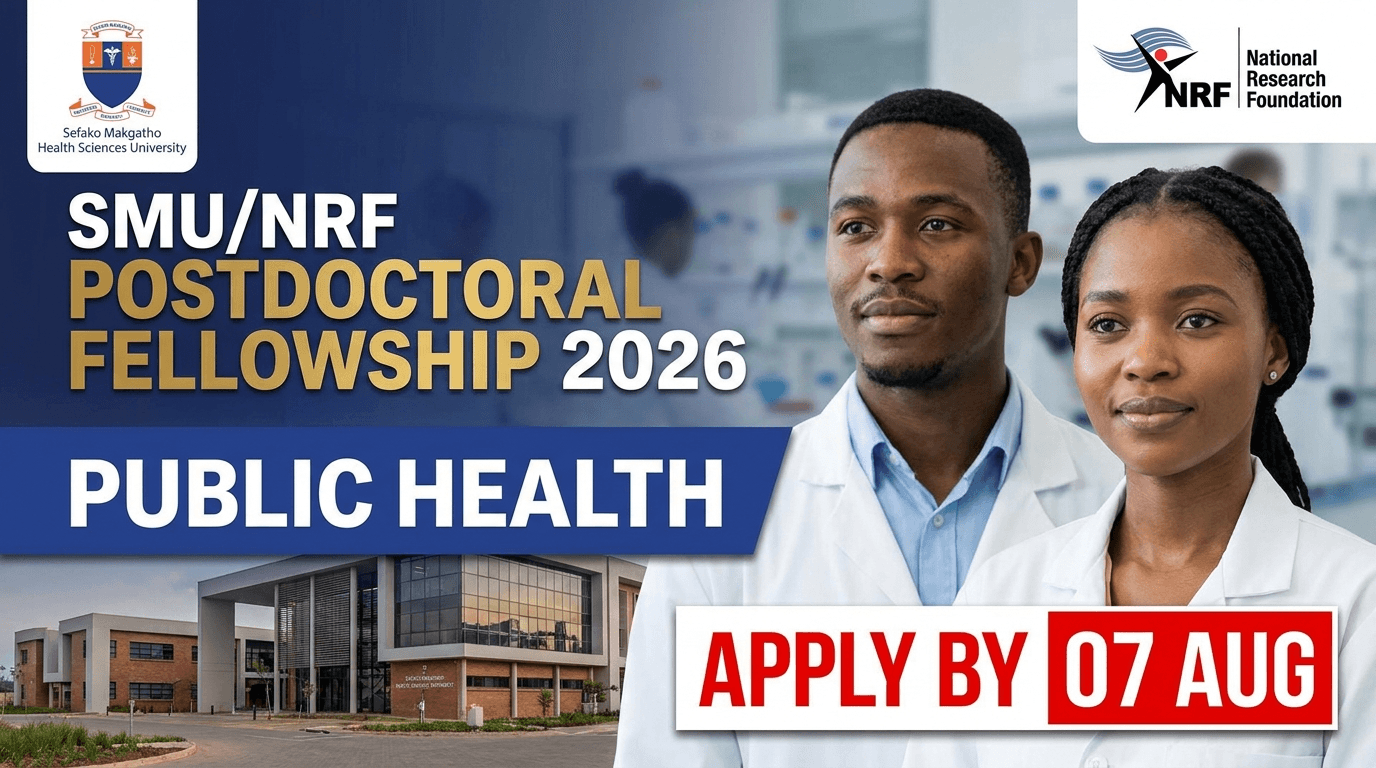

Now is the time to boost your research career with a post‑doctoral fellowship at Sefako Makgatho Health Sciences University. The programme closes on 07 August 2026, so act quickly if you want to join a leading health‑science team in Gauteng.
What the opportunity is
The National Research Foundation and SMU are offering a two‑year Postdoctoral Research Fellowship in the Department of Public Health. The fellowship is part of the NRF SARChI STRIDES@SMU research programme and focuses on sexual and reproductive health, digital health solutions, social epidemiology, infectious‑disease prevention, health literacy and implementation research.
Who can apply
- PhD completed within the last five years.
- Doctoral discipline in Health Informatics, Computer Science, Information Systems, Biostatistics, Biomedical Engineering, Public Health, Nursing, Pharmacy, Statistics, or a related health‑ or social‑science field.
- South African citizen or permanent resident (proof required).
- Demonstrated expertise in at least one area: mobile health apps, website development, digital health innovation, or digital transformation of health systems.
- Proficiency with data‑analysis software such as STATA, SPSS, R, SQL, QRS, NVivo or ATLAS.ti.
- Experience in research data management (designing capture tools, cleaning data, ensuring confidentiality, etc.).
- A solid publication record – peer‑reviewed articles, conference papers, book chapters or reports.
- Good verbal and written communication skills, and the ability to mentor postgraduate students.
What you gain
- R370 000 per year, tax‑exempt.
- Two‑year contract (extension subject to progress report and funding).
- Hands‑on experience in digital‑health research and public‑health implementation.
- Opportunities to publish, present at conferences and supervise master’s or PhD candidates.
- Access to SMU’s research facilities and a supportive academic network.
How to apply – step by step
- Prepare a motivation letter that explains your PhD research, relevant public‑health or digital‑health experience, technical skills, publication record and how you will contribute to STRIDES@SMU.
- Write a one‑page research‑interest summary outlining your current work, methodological strengths and proposed contributions to sexual‑reproductive health and digital‑health interventions.
- Update your CV and include a full list of publications.
- Obtain certified copies of your ID or passport, academic transcripts and qualification certificates (no older than six months). If you hold foreign qualifications, attach a SAQA evaluation.
- Combine all documents into clearly labelled PDF files.
- Email the complete application to researchcapacity@smu.ac.za, addressed to Ms Fulufhelo Malamatsho, before 07 August 2026.
Tips to improve your chances
- Show clearly how your doctoral work aligns with at least three of the research focus areas listed above.
- Highlight any digital‑health projects you built or managed, and specify the software tools you used.
- Include quantitative or qualitative results that were published or presented.
- Provide examples of successful supervision or mentorship of postgraduate students.
- Proof‑read all documents; incomplete or unreadable files will be disqualified.
- Submit well before the deadline to avoid last‑minute technical issues.
Next steps
If you meet the criteria, gather the required documents today and start drafting your motivation letter. The deadline is fast approaching, so send a complete, polished application to the email address above. Good luck – this fellowship could be the launching pad for the next stage of your research career.
