
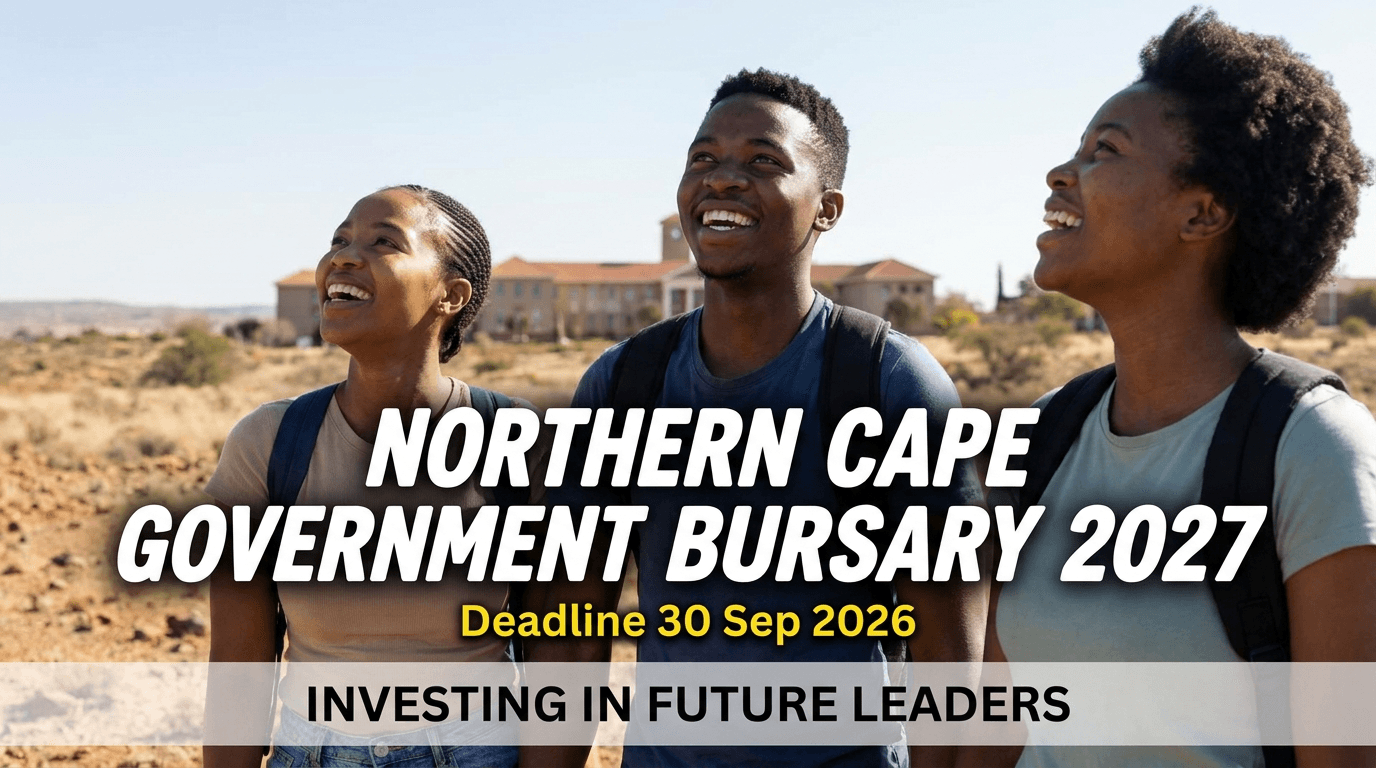

The Northern Cape Provincial Government is offering a bursary for South African students who are unemployed and live in the Northern Cape – but you must act before the deadline on 30 September 2026.
What the bursary is
The Office of the Premier Bursary Programme for 2027 provides financial support for undergraduate studies in fields that are scarce or critical in South Africa. Priority is given to Science, Technology, Engineering and Mathematics (STEM) programmes.
Who can apply
- South African citizen, aged 18–30
- Resident of the Northern Cape
- Unemployed and in need of financial assistance
- Currently completing or already have a Matric certificate
- Enrolled or accepted at a recognised South African higher‑education institution (public institutions are preferred)
- Studying a first‑degree qualification in a scarce‑skill or critical‑skill area
- Can study full‑time or online
What you will gain
- Up to R120 000 per year (amount depends on household income)
- Coverage of registration, tuition, prescribed books and accommodation
- Support for a field that the government urgently needs
- Potential to start a career in a high‑demand sector
How the bursary value is calculated
| Total annual household income | Maximum bursary value |
|---|---|
| R0 – R350 000 | R120 000 |
| R350 001 – R550 000 | R100 000 |
| R550 001 – R800 000 | R80 000 |
The final amount will reflect your financial situation, academic needs and the funding available.
How to apply – step by step
- Download the official form: Northern Cape Provincial Government Bursary 2027 Application Form.
- Complete the form in full. Use the “field of study” section to confirm your programme is eligible.
- Gather the required documents (see list below) and have them certified within the last six months.
- Choose a submission method:
- Email: send to BursAdmin@ncpetf.onmicrosoft.com with the subject line “NCPG Bursary 2027”. Attach the completed form and all certified documents.
- Hand‑delivery: take the package to T&I Office Building, 69 Memorial Road, Monument Heights, Kimberley, 8301. Keep a receipt as proof.
- Submit before 30 September 2026. Late or incomplete files may be rejected.
Required documents
- Completed bursary application form
- Certified copy of your ID
- Certified Matric results (or certificate if already completed)
- Certified latest tertiary transcript (if you are already studying)
- Proof of acceptance or provisional acceptance at your university/TVET college
- Proof of registration (where applicable)
- Curriculum plan for the intended qualification
- All household‑income documents (see “Proof of Household Income” below)
Additional documents for applicants aged 23–30
- SARS confirmation letter showing tax status (must be current)
Documents from parents, guardians or spouse (if requested)
- Identity documents
- Proof of income or recent bank statements
- SARS 2026 Income Tax Assessment or confirmation letter
- Letters from banks confirming accounts
- Affidavits or Department of Labour proof if unemployed
- SASSA slip, marriage certificate, divorce decree, death certificate, or other relevant proof of family status
Proof of household income
- Complete and up‑to‑date income information for all earners
- Current bank statements
- Readable tax documents
- Commissioned affidavits where needed
Tips to improve your chances
- Apply early – collecting and certifying documents can take time.
- Double‑check that every copy is certified and dated within the last six months.
- Make sure your academic results are clear and legible.
- Provide full and truthful financial information; missing data can delay or disqualify you.
- If you have a disability or special circumstance, include supporting letters.
- Keep a copy of everything you send and note the date of submission.
Next steps
If you meet the eligibility criteria, start gathering your documents today. Follow the step‑by‑step guide, send or deliver your application before 30 September 2026, and wait for a response by 26 February 2027. Even if you do not receive the bursary, the process will give you valuable experience for future applications.
