
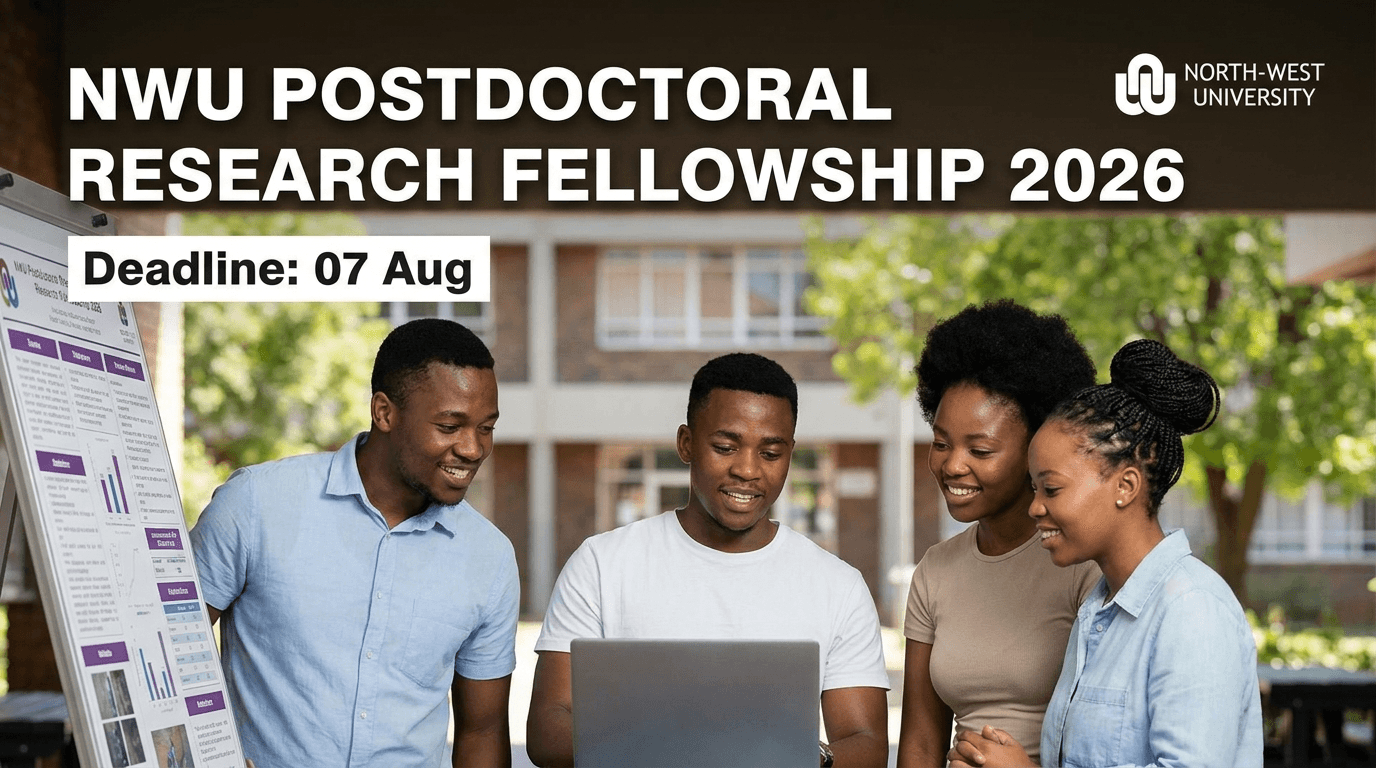

Are you a fresh PhD graduate looking to turn your research into real‑world impact? North-West University is offering a post‑doctoral fellowship that starts soon, so you need to act before the 7 August 2026 deadline.
What the opportunity is
North‑West University’s Faculty of Natural and Agricultural Sciences is hiring a Postdoctoral Research Fellow for the Soil‑Plant‑Microbe Interactions Group on the Mahikeng Campus. The fellowship supports a project that uses multi‑omics, bioinformatics and machine learning to explore how soybeans tolerate soil degradation and changing climates.
Who can apply – eligibility and minimum requirements
- Hold a PhD in Molecular Agricultural Biotechnology, Agricultural Genomics, Computational Biology, Multi‑Omics, or a closely related field.
- Demonstrated ability to analyse agricultural datasets with bioinformatics tools.
- Experience applying data‑science or machine‑learning methods to biological or agricultural data.
- Proficient in Python, R and a version‑control system such as Git.
- Practical laboratory or field experience (e.g., molecular biology, soil or plant sampling, omics techniques).
- A publication record that relates to bioinformatics, multi‑omics, machine learning, agricultural biotechnology or plant‑soil‑microbe research.
- Ability to work independently and to mentor junior students.
What you gain – benefits and skills
- Annual stipend of R320 000 (subject to university policy).
- Relocation assistance up to R20 000.
- Fixed‑term contract with possible extensions up to five years, based on performance and funding.
- Hands‑on experience with cutting‑edge multi‑omics pipelines and agricultural data science.
- Opportunities to publish, present at conferences and build an interdisciplinary network.
- Support for supervising students and contributing to a vibrant research group.
How to apply – step‑by‑step
- Visit the official NWU vacancy page: Apply for the Postdoctoral Research Fellowship 2026.
- Create a new applicant profile or log in to an existing one.
- Complete all required fields in the online form.
- Prepare a single PDF that includes:
- One‑page motivation letter.
- Research‑interest statement.
- Full curriculum vitae (including programming languages, packages, and relevant projects).
- Complete list of publications.
- Names and contact details of three referees.
- Upload the PDF when prompted.
- Double‑check that the reference code SPMIG26 is entered correctly.
- Submit the application before 07 August 2026.
Tips to improve your chances
- Tailor your motivation letter to the soybean multi‑omics project; keep it to one page.
- Highlight any previous work with soil or plant datasets, especially if you used machine‑learning libraries (e.g., scikit‑learn, TensorFlow).
- List specific Python or R packages you have used (e.g., Bioconductor, pandas, ggplot2) and mention your Git workflow.
- Provide concrete examples of reproducible research you have delivered (e.g., public repositories, Docker images).
- Ensure your referees are senior academics who can speak to both your computational and laboratory skills.
- Proofread all documents; a clean, well‑formatted PDF shows attention to detail.
Next steps
If you meet the criteria, start gathering your documents now. The deadline is fast approaching, and a complete, well‑presented application will give you the best shot at securing this fellowship. Good luck, and take the first step toward advancing agricultural biotechnology research in South Africa.
